//
Chargement de l'article...

Chargement de l'article...
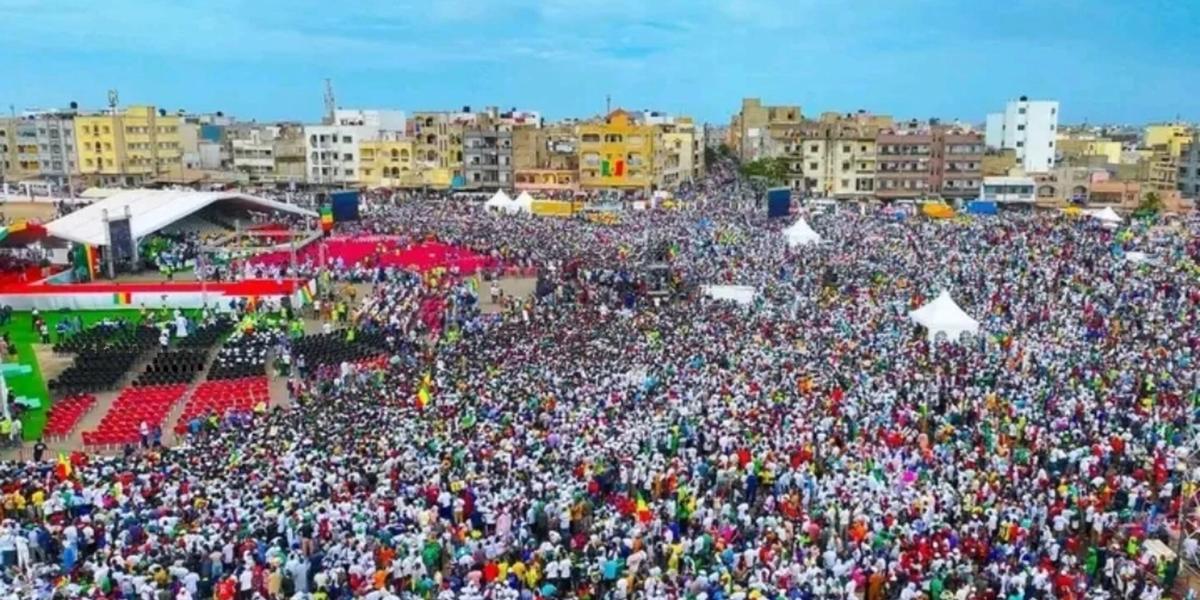
The election of Bassirou Diomaye Faye in March 2024 was already historic, and unexpected to say the least. How could a man unknown to the general public just a few months earlier find himself elected head of state of Senegal, against better-known candidates with undeniable political longevity and legitimacy, such asKhalifa Sall,Idrissa Seck or evenAmadou Ba ? Faye was elected with 54.28%.
Never before in Senegal's political history has an opponent won a presidential election in the first round. On March 24, 2024, the people of Senegal expresseda breakthrough choice. A break confirmed by the results of the legislative elections of November 17, 2024, which gave an absolute majority to the partySenegalese African Patriots for Ethics and Fraternity (Pastef) with 130 out of 165 seats.
The day after his election, in his first address to the Senegalese people, Faye reiterated his firm and unambiguous determination to bring about changes in governance: "Nothing will be as it was before". If Pastef's resounding electoral victory in the legislative elections is anything to go by, this goal has been achieved. This victory is also a sanction of the political class in power until 2024, and now reduced, all parties combined, to the bare minimum.
Doctoral student in political scienceMy work focuses in part on studying the electoral dynamics of this party (and other Senegalese political parties) from a comparative perspective, encompassing both the Senegalese context and that of the diaspora. In the analysis that follows, I examine the key factors that contributed to Pastef's remarkable success in Senegal's recent legislative elections.
Pastef's first participation in a major election dates back to 2017, just three years after its creation. At the end of that election, the party's leader, Ousmane Sonko, under the banner "Ndawi Askan Wi" (Mandataires du peuple) , waselected deputy via "the strongest remains "(allocation of the remaining seats after an initial proportional distribution to the lists with the largest unused decimal fractions) with a total of 37,535 votes, or around 1.13% of the votes cast. Sonko's narrow election to the National Assembly has done much to popularize the party's vision and positioning in Senegal's political landscape.
With a number of high-profile appearances, notably on issues of governance and corruption, Sonko has created his own aura within the hemicycle and in public opinion.
Support our work
2019 marks thethe party's first participation and its real electoral test. Pastef succeeded in passing the "big" sponsorship hurdle along with four other candidates. This enabled it to take part in a highly selective election, composed of five candidates and tailor-made by the government, which excludedtwo major candidates (Khalifa Sall and Karim Wade). But who undoubtedly underestimated Ousmane Sonko at the same time.
The latter, despite limited means, but thanks to Pastef's well-established partisan apparatus, succeeded into third place with 15.67%, behind Macky Sall and Idrissa Seck. Leading very large coalitions with far greater financial and logistical resources than Pastef, the two won 58.26% and 20.51% respectively. The Pastef result confirms the party's growing power. In fact, it has become the main opposition party to President Macky Sall, afterthe rallying of Idrissa Seck to the presidential camp in exchange for aappointment as Chairman of the French Economic, Social and Environmental Council.
Macky Sall's second term in office (2019-2024) will be marked by thea huge influx of "transhumantsto its presidential coalition, while Sonko and Pastef remain faithful to their position and are reinvigorating participatory financing via fundraising, with each militant contributing according to his or her means.
By way of illustration, in January 2024 in Paris, party activists and supportersmobilized 12 5000 000 CFA francs (US$198,586). Pastef has also established itself as the voice of popular frustration, setting up more and more branches across the country, including in rural areas.
As a member of the "Yewwi Askan Wi" coalition, he hasis rewarded for its efforts in the 2022 parliamentary elections, winning 56 seats.
Visittriumph of the party in the legislative elections held on November 17, 2024 is part of this quasi-hegemonic dynamic. Going it alone, without any coalition, Pastef only lost 6 of a total of 45 departments nationwide, against very large political coalitions such as "Takku wallu Senegal "(Unis pour sauver le Sénégal), whose list was headed by former president Macky Sall.Samm-sa-kaddu "(Keeping one's word) or "Jamm ak njarin "(Peace and usefulness) led by former Prime Minister Amadou Ba.
Thispolitical rise owes much to Sonko's charisma: his steadfastness, his endurance in the face of adversity, his loyalty to his principles. Others will add his populist bent. But it also owes much to a kind of renewal of partisan work, characterized by a structural endurance that goes beyond Sonko's leadership. Despite the strong incarnation of the party by its undisputed leader Sonko, Pastef has always given primacy to the project rather than to men.
While other parties have withered or languished following the imprisonment or exile of their leaders, Pastef has proved particularly resilient in the wake ofSonko's imprisonment (July 2023-March 2024), fromBassirou Diomaye Faye and several hundred of its activists and elected representatives. Thanks to this work, the choice of Faye as a candidate, despite the fact that he is incarcerated and little known in the public eye, has hardly been debated within the Pastefian apparatus following Sonko's inability to take part in the March 2024 presidential election.
The party's unprecedented strategy of presentingthree candidates to the presidential election, in order to ward off any possibility of invalidation, seems to have caught the authorities unawares. What followed was a carefully thought-out communication campaign, based on the ingenious slogan: "Diomaye mooy Sonko, Sonko mooy Diomaye" (Diomaye c'est Sonko. Sonko, c'est Diomaye, in Wolof). Apart from a few debates in the public arena about the choice of candidate and his ability to win the loyalty of the Pastefian electorate, there was no acute controversy over the investiture of the former General Secretary of the party, now elected President of the Republic.
Ousmane Sonko, and his presidential candidate, Bassirou Diomaye Faye, hold a joint press conference after being released from prison in March 2024... Cem Ozdel/Anadolu via Getty Images
In view of the above, the rise of Pastef represents a decisive turning point in Senegal's political landscape, marked by a break with the established elites. By winning the March 2024 presidential election and securing an absolute majority in the November 2024 legislative elections, Pastef has succeeded in embodying an alternative project, built around a critique of traditional governance and a profound desire for institutional renewal.
Pastef's ability to overcome institutional obstacles, anticipate challenges and run a strategic campaign has enabled it to distinguish itself as a major player in the Senegalese political system. This series of electoral successes marks a redefinition of the relationship between the political class and Senegalese society, with an underlying movement in favor of transparency and ethics.
Thus, the year 2024 could well be seen as a tipping point for Senegalese democracy, with potentially lasting implications for political practices and the relationship between rulers and ruled, reviving old ideals carried by the Senegalese left.
Pastef articulates a discourse marked by a desire for a break in governance expressed by many Senegalese. The party also crystallizes a number of battles waged by thethe historic Senegalese left :breaking with neo-colonialismA project that takes into account the most disadvantaged social strata, an equitable redistribution of resources, and economic development in line with socio-cultural realities.
In an interview with the newspaper Le Quotidien published on October 30, 2021, Madièye Mbodj, a leading figure in thethe Senegalese left,advancedsaid that Sonko "embodies the new contemporary left". In reality, Pastef's discourse is not new. What is new is the "marketing" of the discourse.
Sonko's talent lies in his ability to identify and agitate issues that are likely to mobilize youth and other social strata (the distribution of wealth, thefight against corruptionThe new government's priorities are to: reduce poverty, combat illicit enrichment, make the Senegalese economy less extroverted, give primacy to the national private sector...).
If in fact the party defends ideals and causes that have had a prominent place in the struggles of theSenegalese left (PIT, LD, AJ/PADS, among others), it should be pointed out that Pastef has never positioned itself as a left-wing party. What's more, since its inception, the party has defined itself as a partisan organization that distances itself ideologically from traditional cleavages (liberalism,socialism,communism...).
It remains to be seen what kind of program this unclassifiable party, which now has a free hand internally, will be able to roll out in a highly restrictive economic and geopolitical context that will put its promises to the test of power.
Source: The conversation.com
Bayaliou
Journaliste et analyste politique